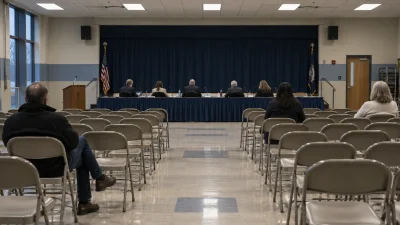

The rule that decides how many two-year-olds one adult can be responsible for inside a federally funded classroom is short enough to read in a minute. One teacher for every four infants or toddlers. One for every eight three-year-olds. One for every ten four-year-olds. It has applied the same way in Bakersfield and in Bangor for decades, and on August 7 the federal government proposed taking it out of the rulebook.
The Administration for Children and Families published a notice of proposed rulemaking called "Reducing Federal Burden for Head Start Programs" in the Federal Register that day. It would rescind parts 1301 through 1305 of the current regulations and replace all of it with one slimmed-down part. Class size, staffing, the language of instruction, how much of a grant can go to administration, how many days a year a classroom has to open its doors: most of that moves from Washington to states and to the roughly 1,600 organizations that run Head Start locally.
What a parent actually needs to know
Nothing has changed in your child's classroom yet. This is a proposal, not a final rule, and the comment period runs until October 6, 2026. Anyone can file a comment at regulations.gov under docket ACF-2026-0595, including parents, including grandparents, including the person who drives the bus. If the rule is finalized as written, the Head Start program performance standards that set a national floor on classroom quality would be replaced by whatever your state's child care licensing rules already require, which in some states is close to the federal number and in others is not close at all.
That is the whole story in one paragraph. The rest is detail, and the detail is where families usually get surprised.
The specific numbers on the table
Under the proposal, programs would have to keep staff to child ratios that are "consistent with applicable state and local laws," and post those ratios somewhere visible to parents. Posting is not nothing. A number on a wall is more than most parents get from a private center. But it is a disclosure requirement standing where a national standard used to be, and disclosure only helps a family that has somewhere else to go.
The administrative cost cap drops from fifteen percent of a program's funding to five percent. The rule's own analysis notes that only a small fraction of grantees currently operate at or below five percent, which means most programs would have to reorganize their back office to comply. Required operating days fall back to a 1994 baseline: at least 128 days a year for four-day programs, 160 for five-day ones. The current standard is 1,020 instructional hours annually. Programs would also be required to conduct all education in English, with an exception carved out for tribal programs teaching heritage languages. The administration's own estimate is that roughly a third of non-tribal classrooms are affected.
An analysis by New America, which read the full text the day it dropped, found the proposal also removes federal requirements for health, dental, vision and hearing screenings, and for monthly mental health consultation. Those are the services that catch a vision problem at four instead of at seven. Head Start has historically been a health program wearing a preschool's clothes, and a lot of families never knew that was the deal they were getting.
The case the government is making
The argument for all of this is money, and the money is not small. ACF estimates the changes are worth between roughly $1.48 billion and $2.96 billion a year at full implementation, with a primary estimate near $2.22 billion. It projects that savings could fund about 116,516 new Head Start Preschool slots and 45,578 new Early Head Start slots by 2031. HHS's press release describes even larger numbers. Treat the slot projections as agency estimates rather than settled facts, because they are exactly that, and the two documents do not fully agree with each other.
Alex Adams, who runs ACF, framed it as a fit problem. "One-size-fits-all mandates from Washington cannot fully account for the realities," he told NPR. That is a real argument. A Head Start center in rural Nevada and one in Queens do not have the same labor market, the same building stock, or the same families walking in the door. Rules written for both sometimes fit neither.
Providers see the same flexibility and read it differently. Jen Bailey, who runs Reach Dane in Wisconsin and heads that state's Head Start association, was blunt with the Wisconsin Examiner: "Changing the staff-to-child ratios is dangerous and a health and safety hazard." Her point is not that flexibility is bad in the abstract. It is that a ratio is the one variable a stretched program will always be tempted to move, because it is the only lever that saves money immediately.
Why the trade is harder than either side admits
More slots at a lower standard versus fewer slots at a higher one is a genuinely difficult call, and families sit on both sides of it. A parent on a two-year waitlist would take a bigger classroom today over a perfect classroom that has no room for her kid. A parent already inside the program hears "flexibility" and pictures her son's teacher trying to manage fourteen four-year-olds instead of ten.
What makes this different from the usual cost-of-care conversation is that it is a rulemaking, not a market. When we wrote about how child care costs rewrote the family budget, the levers were prices and wages and household math. This one is procedural. Early childhood education policy gets set in a docket, and the docket is open. That is unusual, and it expires.
There is a state-level rhyme here worth noticing. New York recently loosened a mandate requiring one curriculum for every preschool classroom, a decision our network covered in a piece on what New York parents should watch next. The pattern is the same in both places: a uniform standard comes off, local discretion goes on, and the quality question quietly becomes a question about where you happen to live. Families who have followed how school budget cuts change a classroom already know how that story tends to run.
How to file a comment that a federal agency will actually read
A federal public comment period is not a vote, and agencies do not count it like one. A thousand identical form letters count for roughly one idea. What moves a rule is specific, first-person evidence that the agency did not have.
So write what you know. Name your program and your state. If your state's licensing ratio is looser than the federal one, say the number, because that comparison is the single most useful thing a parent can put in the record. Describe what the health screening caught, if it caught something. Describe what happens on the days your center is short-staffed. If your child learned in two languages and that mattered, write down why. Keep it to a page. Sign it with your name.
Comments go to regulations.gov under ACF-2026-0595, and the window closes October 6. Head Start programs themselves, state associations, and pediatric groups will file long technical responses about preschool class size rules and cost accounting. Almost nobody will file the sentence that begins "my daughter's teacher noticed." That sentence is the one thing in the docket that only you can write.
What to watch between now and October
Three things. Whether your state's licensing ratios are stricter or looser than the current federal standard, which determines whether this proposal changes anything at all where you live. Whether your program announces changes to health screening, since that is the piece most likely to move quietly. And whether the final rule keeps the English-only instruction requirement, which has drawn the sharpest objections and is the provision most likely to be revised.
Head Start classroom quality has never been a single thing. It is a ratio, a screening, a bilingual aide, a building that opens 180 days instead of 128. The proposal touches all of them at once, which is why it is hard to argue about cleanly and easy to ignore until it is finished. Child care regulations 2026 will be written either way. Family advocacy in rulemaking is not glamorous work and it does not always succeed. It does, however, leave a record, and records get cited when the final rule is written.
The comment box is open until October 6. It costs a page and a name.