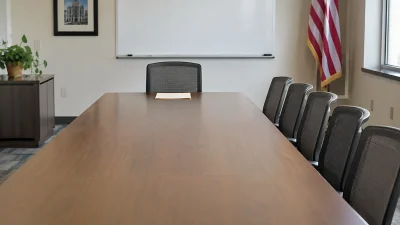
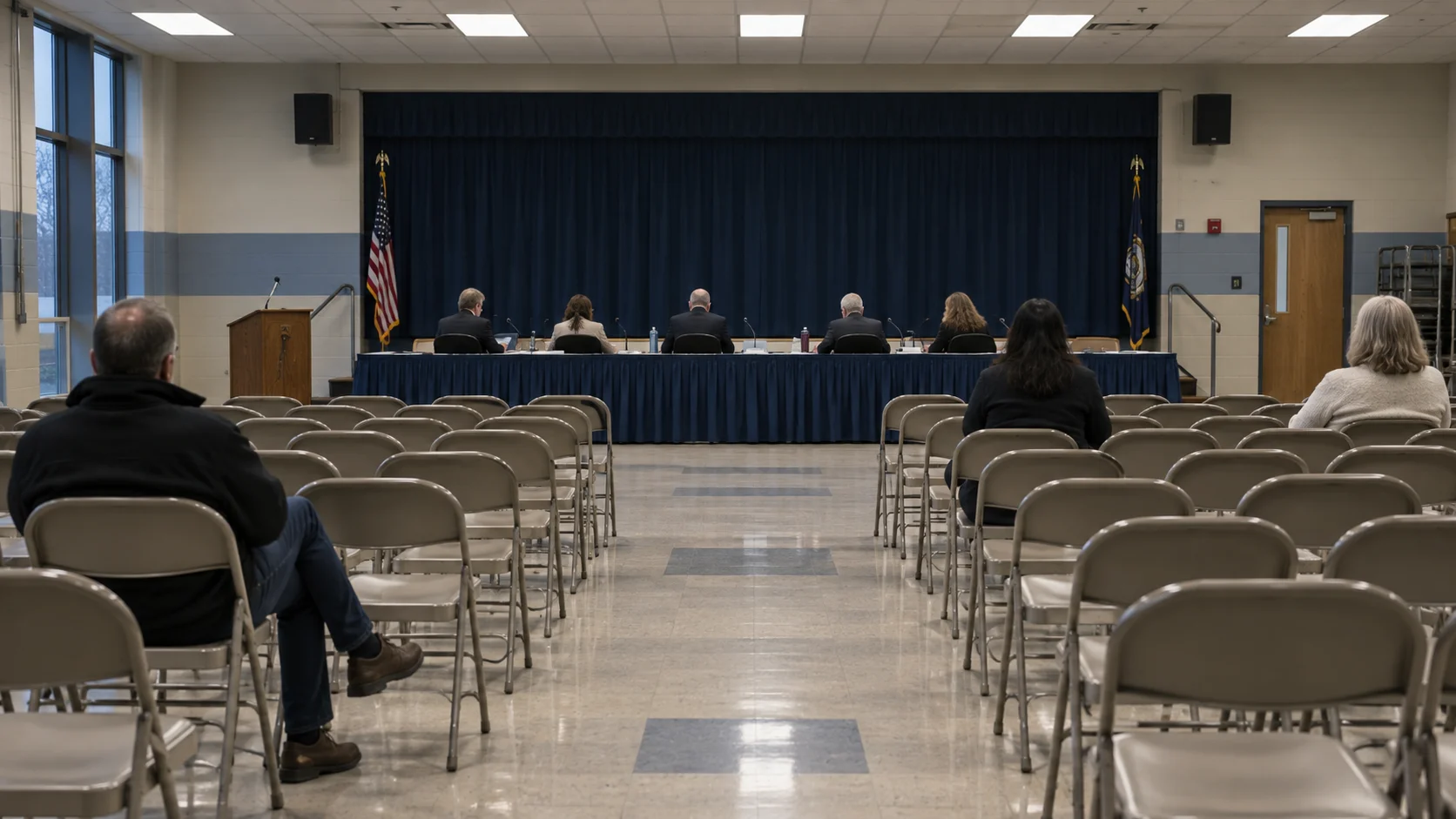
Somewhere in your district, probably on a weeknight at seven, between five and nine people will sit at a table and vote on things that shape your child's year. They will approve a budget, sign off on a bus contract, set the calendar, hire an administrator and decide whether a program survives another twelve months. The meeting is public, its date was posted in advance, and in most districts the seats behind them will be close to empty.
The National School Boards Association puts turnout in school board elections at often 5 to 10 percent of eligible voters. Newark typically sees three to four percent. An Oklahoma City election in April 2024 drew a few hundred voters in a city of more than 700,000.
Those numbers describe an opportunity rather than a crisis. When the electorate for a governing body is that small, the arithmetic of influence runs in a parent's favor in a way it never does in a presidential year, and the entry cost is a calendar entry rather than a campaign. The local civic calendar is the most underused family resource in the country, and knowing how it works takes about ten minutes.
What the Law Guarantees, and What It Does Not
Every state and the District of Columbia had passed an open meetings law by 1976. Those laws share a spine: public bodies must meet in the open, give advance notice, and keep minutes. New York defines the covered bodies broadly, naming city councils, town boards, village boards of trustees, school boards, commissions, legislative bodies and committees, and states plainly that the public has the right to attend, listen to debate and watch the decision-making process.
Here is the distinction that catches most first-time attendees, and it is worth internalizing before you arrive. These laws guarantee a right to attend. They do not generally guarantee a right to speak.
The Ohio School Boards Association answers the question directly in its own guidance, noting that state law requires deliberation in open meetings but that there is no legal requirement that those meetings afford the public an opportunity to comment or otherwise participate, while adding that nearly all Ohio districts provide the opportunity voluntarily. The ACLU of Washington states the same thing about its state's Open Public Meetings Act. New Jersey runs the other way, requiring that board meetings contain a public comment period, with boards free to set reasonable limits on time per speaker.
New York requires public notice at least 72 hours before a meeting scheduled a week or more in advance, posted conspicuously and, where practicable, on the body's website. Texas requires posting at least three business days ahead, and for budget meetings it goes further, requiring that the proposed budget itself accompany the notice or sit clearly accessible on the home page along with a taxpayer impact statement. New Jersey requires 48 hours. Agendas are a different matter, and in many states they are custom or local policy rather than statute.
Who Is in the Room Right Now
The best portrait of who attends local public meetings comes from Katherine Levine Einstein, Maxwell Palmer and David Glick, who read the minutes of meetings across 97 cities and towns in metropolitan Boston between 2015 and 2017, identified 3,123 participants and matched 2,580 of them to the voter file. The people who showed up averaged 58.7 years old against 50.9 for non-participants. They had lived at their address for 17.4 years against 11.8. They voted in roughly twice as many elections.
Women were 51.3 percent of the voter file and 43.3 percent of commenters. In the Arlington sub-sample, renters made up 39 percent of the population and 22 percent of meeting participants. That research covered land use and planning meetings in one metropolitan area rather than school boards nationally, and the skew it documents is the one every parent organizer describes anecdotally.
The composition of the boards themselves follows a parallel pattern. Ballotpedia's analysis of more than 82,000 school board members in 2022 and 2023 found 52 percent were men, and a National School Boards Association survey in 2017 and 2018 found 78 percent of members identified as white. Research by Vladimir Kogan, Stephane Lavertu and Zachary Peskowitz covering school board elections in four states from 2008 to 2016 found that in at least two-thirds of districts where the majority of students were racial and ethnic minorities, the majority of voters were white.
Two Minutes, and What They Are Worth
Public comment is typically capped at two or three minutes. Laura McKenna, a New Jersey parent and former special education teacher, offers the most useful unit of measurement anyone has published on this: three minutes equals about a page and a half of words. Write it out, read it aloud, and cut.
Boards may regulate the time, place and manner of participation, and Ohio's guidance describes limiting individuals to three minutes and total public participation to thirty. What boards may not do is discriminate between speakers based on the content of their speech. Michele Jones, general counsel at a New York BOCES, writing for the school superintendents association, notes that fair limitations should be neutral, covering time, topic, sign-in requirements and prohibitions on vulgarities or threats, and that comments cannot be limited in a viewpoint-restrictive manner. One board that turned off a microphone during criticism was found to have engaged in viewpoint discrimination.
Rules shape participation more than motivation does, and Denver provides the clearest natural experiment. Its board adopted new limits in December 2024, cutting individual comment from three minutes to two. Signups had already fallen from 653 people across eleven meetings in 2022 to 510 in 2023 and 339 in 2024. In 2025 they hit 145, a 77 percent decline from 2022, and in both January and June of that year exactly one person signed up.
People are just not signing up for public comment. I think there's this perceived notion that they're not going to get on the list.
That is Kimberlee Sia, a Denver board member, as the board weighed reconsidering the limits it had adopted a year earlier. A district teacher, Dez Baldonado, opened her own comment by apologizing for speaking so quickly, explaining that the two-minute limit made it necessary in order to share everything she wanted to, in reporting by Chalkbeat Colorado.
Expect not to be answered. New Jersey's school boards association tells its members the comment period is for listening rather than for debate, and boards are not required to respond to questions. Getting an item onto the agenda is a separate process that runs through the district office or board secretary, and it is local everywhere. There is no national mechanism for it.
The Meeting Federal Law Already Owes You
One meeting on the calendar is not discretionary, and most parents have never heard of it. Under federal law governing Title I schools, every participating school must convene an annual meeting, at a convenient time, to which all parents of participating children are invited, to inform them of the school's participation.
The same statute goes past the meeting itself. Schools should offer a flexible number of meetings, such as morning or evening sessions, and may provide transportation, child care or home visits with Title I funds. Districts must reserve at least one percent of their allocation for family engagement work, with not less than 90 percent of the reserved funds distributed to schools and priority given to high-need schools. Parents are supposed to jointly develop the district's written family engagement policy and the school-parent compact, and information must be provided in a format and, to the extent practicable, a language that parents understand.
A parent who asks a Title I school to fund child care so families can attend an evening meeting is asking for something the statute explicitly contemplates. That is not a favor, and the funding line exists whether or not anyone requests it.
The Rest of the Calendar
Library boards, parks and recreation commissions, county health and child care advisory boards and town councils are public bodies under the same open meetings framework in most states, and they set hours, programming and fees that touch family life weekly.
Libraries in particular carry more family programming than their budget hearings suggest. The Public Library Association's 2022 survey of 1,167 libraries found 95.1 percent offering early literacy programs such as storytime and play-and-learn, 98.8 percent running summer reading for children, 80.3 percent offering STEAM programming and 61.2 percent running family engagement programs. Federal library survey data for fiscal 2023 put the median number of programs per library at 202, more than double the 76 recorded in fiscal 2021.
Budget mechanics vary more than anything else on this list. New York holds a statutory public vote on school district budgets on the third Tuesday in May, and every district except the Big 5 city districts and special act districts must put its spending plan before voters. Almost everywhere else the lever is the hearing rather than a ballot, which makes the notice requirements above the thing that matters. Parents who have watched a program disappear already know how quickly these decisions move, a pattern we traced in our reporting on how budget cuts change a classroom.
The Honest Case for Showing Up
It would be easy to end by promising that civic attendance lifts your own child's achievement, and the research does not support that promise. A meta-analysis of 55 studies covering 106,221 participants found the effect of parental involvement on academic achievement was positive and small, at a correlation of .09, and the authors noted the included studies were correlational. Keith Robinson and Angel Harris assessed more than sixty measures of parental participation for a Harvard University Press book and concluded that no clear connection exists between parental involvement and improved student performance.
Boards elected by 5 to 10 percent of voters set budgets, bus routes, calendars and staffing for every child in the district, and comment periods contract when nobody uses them and expand when someone objects. Public comment records shape policy in ways parents rarely see, as when a state rulemaking comment record turned into the central evidence of an unfunded mandate.
Jonathan Collins, an assistant professor of education at Brown University who studies school board meetings, is realistic about the product he is defending. There are more than 13,000 school boards in the United States and each one meets monthly, he has noted, and people have told him that going to the meetings is like watching paint dry. His research found that meetings structured for dialogue rather than announcement changed how residents felt about participating, and his summary of the goal is worth keeping.
We want these meetings not to be illusions of democracy, but real examples of democracy at work.
Start with one. Find the district calendar, note the next budget hearing, and read the agenda if one is posted. If the timing is impossible because of work or child care, say so in writing to the board secretary, because meeting times are a policy choice and policy choices are exactly what these bodies exist to make. Parents have already used that route to reopen questions about class size and staffing ratios, as we reported when a federal rule put ratios back on the table.