
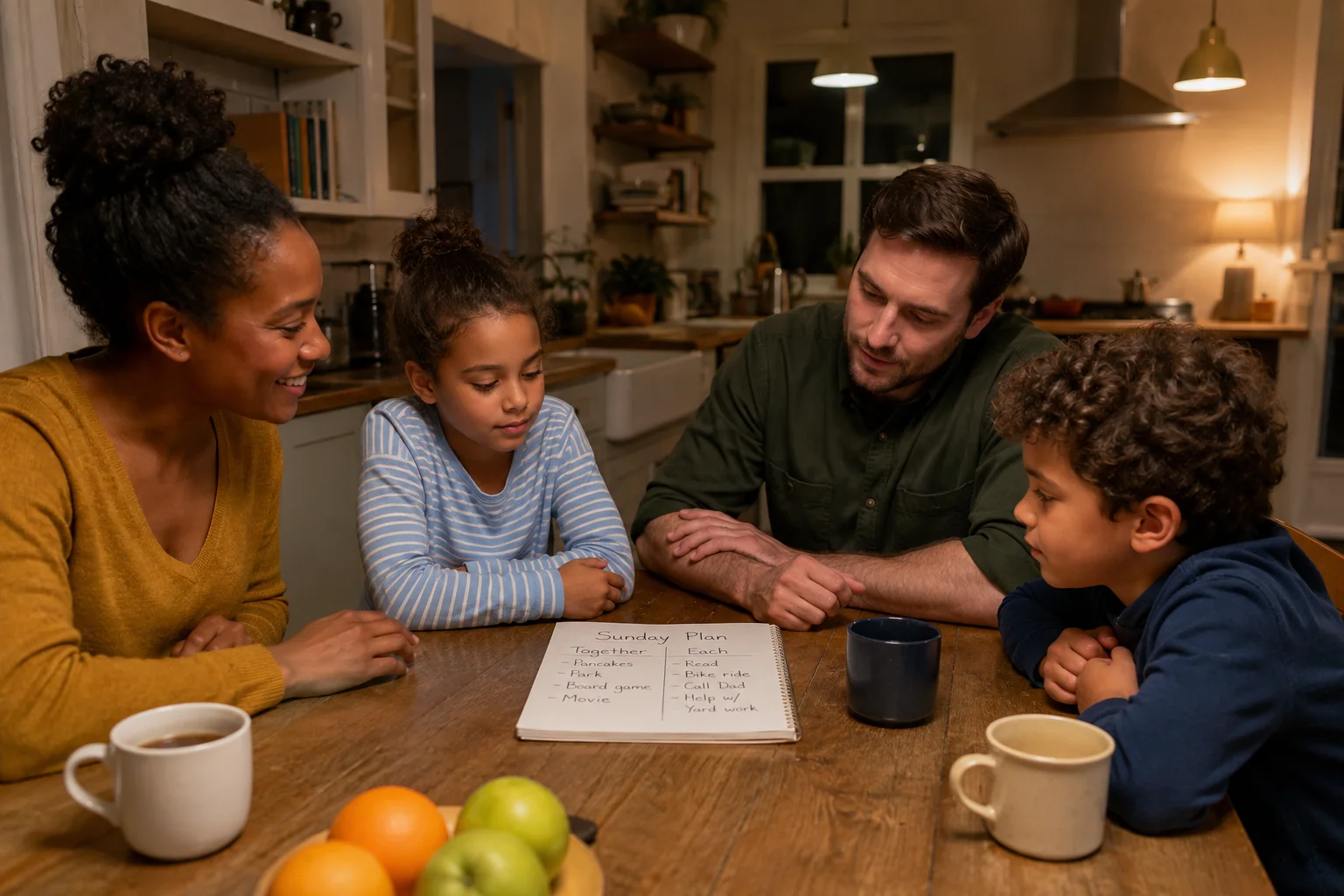
Every household has a version of the same Sunday night. Someone realizes, at nine o'clock, that there is no clean uniform for Monday's game. Someone else discovers the field trip form was due Friday. A third person mentions, almost as an afterthought, that they are dreading school on account of a fight with a friend that nobody knew about until just now. None of this is a crisis. All of it is avoidable. And the fix, according to a surprisingly deep body of family research, is not a better calendar app or a stricter bedtime. It is twenty minutes, once a week, at a table, with everyone present.
Call it a family meeting, a family huddle, a Sunday check-in, or whatever name survives the eye rolls of a teenager who has just been asked to attend one. The label matters less than the habit underneath it: a short, recurring, low-drama gathering where a household coordinates its logistics, resolves its friction, and reminds its members that they are on the same team. Done consistently, it is one of the more evidence-backed, least expensive tools available for reducing household stress, and it works precisely because it replaces reactive parenting with a rhythm the whole family can count on.
Why the Research Backs the Kitchen Table
This is not a wellness trend dressed up as science. Psychologist Barbara Fiese and colleagues at Syracuse University conducted a review spanning five decades of research on naturally occurring family routines and rituals, published in the American Psychological Association's Journal of Family Psychology. The review found that consistent family routines were tied to stronger marital satisfaction, a clearer sense of identity in adolescents, better child health outcomes, and more cohesive family relationships overall. A weekly meeting is, in essence, a routine engineered on purpose rather than one that happens by accident, and it inherits the same benefits that Fiese's research attaches to routines more broadly.
The most widely used framework for running these gatherings comes from the positive discipline model, developed decades ago by psychologist Jane Nelsen and still taught in parenting programs nationwide. Its version of a family meeting follows a simple arc: start with appreciations, review the calendar, work through agenda items collaboratively, and end with something the family actually enjoys. That structure matters because it keeps family communication from collapsing into a parent delivering a list of grievances. It is also worth being honest about the limits here. Not every family needs a formal meeting to function well. Researchers who study family dynamics have noted that households already engaging in relaxed, constructive conversation at the dinner table may find a bolted-on meeting redundant, and that a meeting run badly, as a lecture disguised as a discussion, can do more harm than skipping it entirely. The habit only earns its benefits when everyone genuinely gets a voice.
The Weekly Check-In: Trading Chaos for a Shared Calendar
The simplest and most immediately useful function of a family meeting is logistical. Weekly check-ins give everyone in the house a chance to say what is coming: a practice that got moved, a project due Thursday, a friend sleeping over Saturday. This alone eliminates a huge share of the friction that builds in busy households, because most family stress is not caused by any single event. It is caused by surprise. A conflict that would have been a two-minute conversation on Sunday becomes a five-alarm scramble on Wednesday morning simply because no one said it out loud in advance.
This is also where the meeting habit intersects with something Family Symposium has covered before: the difference between a full schedule and a present parent. A packed calendar can still leave kids feeling unmoored if nobody is actually paying attention to them amid the logistics. A weekly check-in flips that dynamic. It is not another obligation stacked onto an already full week. It is the one recurring block of time where the schedule itself becomes the subject, which frees up the rest of the week for the family to simply be present with each other instead of managing a constant stream of last-minute surprises.
Chore Planning Kids Will Actually Follow
Chore charts fail for a predictable reason: they are usually built by one parent and handed down, which means children have no ownership over them and, in turn, no real investment in following them. Chore planning done inside a family meeting works differently because kids help build the system rather than inherit it. Research on family meetings has repeatedly found that children are more likely to complete chores they had a hand in choosing, and more likely to accept the consequences of skipped chores when they helped set those consequences in the first place.
A practical version of this looks like a rotating list, reviewed every week, where each child picks from a short menu of age-appropriate tasks rather than being assigned one. Disputes over fairness, who did the dishes last, whose turn it is to take out the trash, get resolved in the meeting itself instead of turning into a running argument that resurfaces every few days. Over time, this single change tends to reduce one of the most common and most avoidable sources of daily household friction.
School Preparation Without the Sunday Night Scramble
The same twenty minutes that sync a family's calendar can also front-load the parts of school life that otherwise ambush a household at the worst possible moment. A recurring meeting is the natural place to check homework loads for the week ahead, confirm early dismissals, lay out uniforms or supplies, and catch a permission slip before it becomes a Thursday-night emergency. Families dealing with the transition back into a school-year routine after a looser summer schedule face a version of this same challenge, and a gradual, planned reset tends to go far better than an abrupt one imposed the night before classes start. A weekly meeting gives a family a built-in checkpoint to make that reset happen in manageable steps rather than all at once.
This is also where a family meeting quietly does some of its best work for kids specifically. A child who knows Tuesday's project is coming up in the family meeting rotation is a child who is less likely to be blindsided by it. Predictability, more than any particular parenting technique, is what actually lowers a kid's baseline anxiety about school logistics.
Conflict Resolution: Turning Arguments Into Agenda Items
This is the part of the meeting most parents are actually hoping will work, and it is also the part most likely to go sideways if it is handled wrong. The goal of conflict resolution inside a family meeting is not to relitigate every sibling squabble from the week. It is to create one designated, low-stakes forum where recurring friction gets addressed calmly instead of in the heat of the moment, when everyone involved is already frustrated and least equipped to listen.
The mechanics matter here. Family therapists who work with this format generally recommend framing agenda items around the issue rather than the individual, so a disagreement about screen time becomes "how do we want to handle devices after dinner" rather than "why does he always ignore the rule." Ground rules like no interrupting and no assigning blame help keep the conversation from reopening old wounds. Discipline for a specific incident still belongs in a private, one-on-one conversation, not the family meeting. The meeting's job is prevention and pattern-breaking, not punishment.
Budgeting Conversations Families Can Actually Have
Budgeting conversations tend to get avoided in households entirely, either because parents assume kids are too young to handle the details or because money is simply an uncomfortable subject. A family meeting offers a low-pressure, age-appropriate venue to change that. This does not mean opening the full checkbook to a nine-year-old. It might mean a five-minute segment where the family reviews an upcoming expense, like a birthday party or a school trip, and talks through the tradeoffs together.
These conversations pair naturally with the kind of budget awareness Family Symposium has written about before, including how small, recurring convenience purchases quietly compound into real money over a year. A family meeting is a natural place to surface exactly that kind of spending, since it is often invisible until someone sits down and actually looks at it together. For kids, watching parents talk through a real financial decision, even a small one, does more to build financial literacy than any allowance chart ever will.
How to Start This Week
None of this requires a perfect system on day one. Pick a recurring time that already exists in the family's week, Sunday evening or a weeknight after dinner tends to work well, and keep the first few meetings short and low-stakes. Start with something everyone can say without conflict, a highlight from the week or a plan for the weekend, before moving into calendar review, chores, and anything that needs resolving. End on something the family enjoys, even if it is just choosing what to watch together afterward.
The habit will feel a little awkward at first, particularly with older kids who have learned to associate family gatherings with lectures. That resistance tends to fade once the meeting proves, week after week, that it actually solves problems rather than creating new ones to sit through. Family routines built on consistency, not perfection, are what the research keeps pointing back to, and a family meeting is one of the simplest routines a household can build without spending a dollar or adding a single item to an already crowded week.
Twenty minutes is a small ask. What it buys back, in fewer Sunday-night scrambles and fewer arguments that fester all week, is often worth far more than the time it costs.