
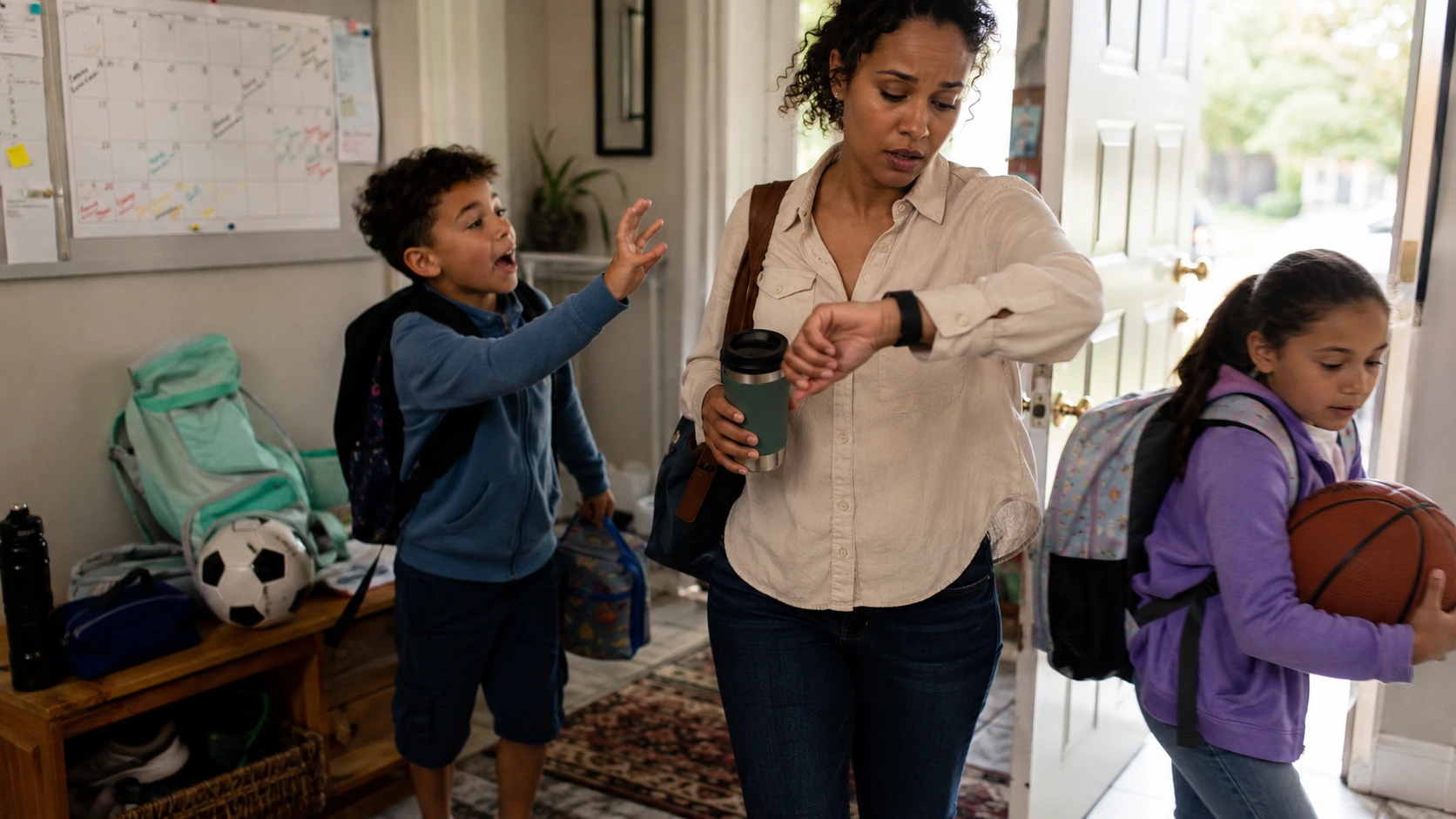
There is a particular kind of parental exhaustion that arrives after the last pickup of the day. The backpack is in the hallway, the cleats are drying near the door, dinner is late, and someone still has homework. The family calendar is full enough to qualify as a second job. From the outside, it can look like devotion in its most organized form.
And often, it is devotion. Parents enroll children in sports, tutoring, music, clubs, enrichment programs, and community activities because they want to give them every possible advantage. The problem begins when a full schedule quietly becomes the primary evidence that a child is being well parented. A parent can spend hours driving, paying, planning, packing, and coordinating while still having very little unhurried contact with the child sitting three feet away.
The hidden cost of busy parenting is not simply fatigue. It is the possibility that family life becomes highly managed but emotionally thin. Children may receive opportunities without receiving enough moments in which they feel noticed, heard, understood, and enjoyed. The goal is not to reject activities. It is to remember that a calendar can support childhood, but it cannot replace a relationship.
Children Need More Than Access to Opportunities
Extracurricular activities can be deeply valuable. Sports can build confidence and teamwork. Music can develop discipline and creativity. Clubs can help children find friends, interests, and a sense of belonging. Tutoring can close academic gaps. None of these things are the enemy.
The trouble comes when parents confuse exposure with connection. A child may have access to excellent coaches, teachers, programs, and facilities, yet still wonder whether anyone at home has time to hear the full version of what happened during lunch. They may be performing, improving, and achieving while privately feeling that their value is attached to what they produce.
Research on emotional availability has linked the quality of parent-child emotional interactions with outcomes including attachment security, emotion regulation, and school readiness. In practical terms, children benefit when caregivers notice their signals, respond sensitively, and remain emotionally reachable. That does not require constant entertainment or perfect patience. It requires a relationship in which the child expects that their parent will turn toward them often enough to matter.
The Center on the Developing Child at Harvard University describes responsive back-and-forth exchanges between children and caring adults as "serve and return" interactions. These ordinary moments help shape the developing brain and support later learning, emotional well-being, and social skills. A child points, asks, complains, jokes, hesitates, or tells a story. The adult notices and responds. The interaction may last twenty seconds, but its message is larger: I see you. What you communicate matters. We are in this together.
When the Family Calendar Becomes a Measure of Love
Modern parenting is frequently conducted under pressure. Families are told that children need early exposure, competitive preparation, specialized coaching, academic acceleration, volunteer experience, leadership opportunities, and a carefully documented list of accomplishments. Parents may fear that saying no to one more activity means closing a future door.
There is also a social dimension. Busy children can make parents feel responsible, ambitious, and attentive. An empty afternoon may look like wasted potential, while a packed week can feel like proof that the family is doing everything possible. Yet childhood is not a college application in progress. It is a period of development that requires movement, rest, boredom, conversation, play, mistakes, and time that has not already been assigned a purpose.
The American Academy of Pediatrics has warned that extracurricular activities can become a source of stress when children never get a break. The Academy also emphasizes the value of unstructured play and downtime for physical activity, social engagement, emotional well-being, reflection, and stress reduction. A healthy schedule should therefore be judged not only by what it contains, but also by what it leaves available.
That available space is where parent-child connection often grows. Children disclose important things while helping with groceries, sitting in traffic, folding laundry, walking the dog, or lingering after dinner. These are rarely scheduled as "quality time." They are low-pressure openings in which a child does not feel interviewed. When every transition is rushed, those openings disappear.
Presence Is Not the Same as Proximity
A parent can attend every game and still be emotionally absent. A parent can work long hours and still create a strong sense of connection. The difference is not measured only in minutes. It is shaped by attention, predictability, warmth, and responsiveness.
Parental presence means that a child can reach the adult emotionally, not merely locate them physically. It looks like putting the phone down when the child begins telling a complicated story. It means noticing that "fine" does not sound fine. It means asking a follow-up question because the first answer was incomplete. It means being able to sit beside disappointment without immediately turning it into a lecture, a solution, or a motivational speech.
Presence also includes delight. Children need adults who do more than monitor their grades, correct their behavior, and transport them to obligations. They need to feel that their company is welcome. Laughter, shared rituals, private jokes, kitchen conversations, and a parent's genuine curiosity all communicate belonging.
This is especially important as children grow older. Teenagers often appear to reject parental attention while quietly monitoring whether it remains available. They may offer information indirectly, at inconvenient times, or in fragments. A parent who is always rushing to the next task may miss the opening. A parent who has built a pattern of listening is more likely to hear what the teenager is actually trying to say.
The Emotional Cost of Being Constantly Rushed
Overscheduling does not affect every child in the same way. Some children thrive with structure and enjoy moving between activities. Others become irritable, anxious, withdrawn, physically tired, or unusually resistant. The central question is not whether a schedule looks impressive. It is whether the child is functioning well inside it.
A constantly rushed household can unintentionally teach children that rest must be earned, productivity is the safest route to approval, and ordinary time has little value. Children may become skilled at meeting expectations while losing touch with their own limits. They may struggle to identify whether they are tired, overwhelmed, lonely, or simply no longer interested in an activity.
Parents can also become less emotionally regulated when the schedule leaves no margin. A forgotten water bottle becomes a crisis. A slow-moving child becomes an obstacle. A traffic delay becomes a family argument. The parent is not uncaring. The system is overloaded.
This matters because caregiver sensitivity depends partly on the adult's capacity to notice and interpret a child's signals. When parents are depleted, distracted, or racing against the clock, they may respond to the inconvenience of a child's behavior without recognizing the need underneath it. The meltdown may be fatigue. The attitude may be embarrassment. The refusal may be anxiety. The silence may be a request for closeness that the child cannot name.
Quality Time Is Usually Built From Ordinary Time
The phrase "quality time" can create another impossible standard. It suggests that connection must be memorable, carefully planned, and emotionally successful. That belief can send parents searching for elaborate outings while overlooking the relationship-building power of daily routines.
Quality time with children is often repetitive and unimpressive. It is the same bedtime conversation, the same walk to the bus stop, the same Saturday breakfast, or the same five minutes sitting on the edge of the bed. Its power comes from consistency. The child knows the moment will return.
Predictable rituals create emotional safety because children do not have to compete for access. A parent might establish ten phone-free minutes after school, one shared meal several nights a week, a weekly walk, or a bedtime check-in. The ritual does not need to be long. It needs to be protected.
During that time, the parent's task is not to extract a report. Questions such as "How was school?" often produce one-word answers because they are broad and familiar. More specific curiosity works better: What made you laugh today? What felt unfair? Who did you sit with? What was harder than you expected? What do you wish an adult had noticed?
Children Also Need Unstructured Time
A child who has no scheduled activity is not necessarily doing nothing. They may be recovering, imagining, experimenting, reading, moving, daydreaming, arguing with a sibling, inventing a game, or learning how to tolerate boredom. Those experiences are part of development.
Unstructured play gives children opportunities to make decisions, negotiate rules, solve problems, and discover what interests them without an adult directing every step. Downtime also allows the nervous system to settle. For adolescents, unstructured time may look less like traditional play and more like music, drawing, casual conversation, walking, or simply having room to think.
Parents sometimes fear that open time will immediately become screen time. That concern is reasonable, but the answer does not have to be another organized program. Families can create screen boundaries while preserving freedom. A child can choose among outdoor play, reading, building, art, helping with a meal, visiting a friend, or resting. The key is that every hour does not need to produce a measurable outcome.
How to Tell Whether Your Family Is Overscheduled
There is no universal number of activities that makes a family too busy. The same schedule may energize one child and exhaust another. Instead of counting activities, parents can examine the family's patterns.
Warning signs include frequent arguments during transitions, chronic lateness, skipped meals, reduced sleep, unfinished schoolwork, recurring complaints of headaches or stomachaches, loss of enthusiasm, and a child who rarely has time to see friends casually. Parents should also notice their own behavior. If most conversations are instructions, reminders, corrections, and countdowns, the family may need more relational space.
Another useful question is whether the child has permission to quit. Some discomfort is part of learning commitment, and children should not abandon every activity after a difficult day. Still, a child should be able to say, "This is too much," without being accused of laziness or ingratitude. Parents can distinguish between temporary frustration and a sustained pattern of stress by listening over time.
A More Sustainable Family Schedule
The solution is not to empty the calendar overnight. It is to build family routines that protect connection as intentionally as the family protects practice, tutoring, or appointments.
Start by identifying one activity that matters most to the child, not the one that looks most impressive to adults. Then examine the total cost of participation, including travel, preparation, sleep, homework pressure, sibling disruption, and parental stress. An activity that is beneficial in isolation may be harmful when combined with everything else.
Next, schedule margin. Leave at least one recurring block of time that is not assigned to performance, errands, or obligations. Treat it as necessary rather than leftover. Families can also create transition buffers so that every departure is not an emergency.
Protect small rituals of emotional connection. Put devices away during one meal. Sit in the car for two minutes before going inside. Ask one real question at bedtime. Invite the child to help with an ordinary task without turning it into a lesson. These practices are not glamorous, but they are repeatable, and repeatable care is what children learn to trust.
Finally, let the schedule reflect the family's values. If connection, health, faith, creativity, service, rest, or extended family relationships matter, those values should be visible in how time is used. A calendar that contains only achievement sends a message, even when parents never intend to send it.
Presence Does Not Require Perfect Parenting
Many parents will read this argument and feel guilty. That is not the goal. Families are busy for real reasons. Parents work multiple jobs, care for relatives, manage long commutes, navigate school demands, and try to provide opportunities they may not have had themselves. The answer is not to romanticize endless free time that many households do not possess.
Children do not need constant access to a calm, fully rested adult. They need enough moments of genuine responsiveness to form a reliable pattern. They need repair after disconnection. A parent can say, "I was rushing and I did not listen well. Tell me again." That sentence itself is presence.
Nor does presence mean removing expectations. Children still need chores, limits, academic support, and accountability. Emotional availability is not permissiveness. In fact, children are often more able to accept correction when the relationship also contains warmth, curiosity, and respect.
The most important shift is conceptual: parenting is not only what adults arrange for children. It is also how adults are with them. The ride to practice matters, but so does the conversation in the car. The recital matters, but so does whether the child feels loved after missing a note. The tutoring matters, but so does whether the parent notices exhaustion.
The Schedule Is a Tool, Not a Test
A full calendar can offer children community, skill, confidence, and joy. It becomes costly when it crowds out sleep, play, family rituals, and the emotional exchanges that tell a child they are known beyond their achievements.
The healthiest family schedule is not necessarily the emptiest or the busiest. It is the one that leaves enough room for a child to be more than a participant, student, athlete, performer, or future applicant. It leaves room for the child to be a person in relationship with people who love them.
Years from now, children may remember the championship, the recital, or the summer program. They are also likely to carry something less visible: the memory of whether home felt like another place to perform or a place where they could exhale. Perfect schedules are temporary. Responsive parenting becomes part of the child's inner voice.