On the night the New York Knicks defeated the San Antonio Spurs 94-90 in Game 5 of the 2026 NBA Finals, something happened that no sports highlight can fully capture. Across this city and far beyond it, people who had been waiting for this moment for decades, some of them their entire lives, finally exhaled. And in that exhale was something more than sports. It was the release of a kind of faith that modern life rarely asks of us and rarely rewards: the faith that if you stay loyal to something long enough, if you keep showing up through the disappointments, the rebuilding years, the heartbreaking losses, the wait itself will one day mean something special.
The Knicks last won the NBA championship on May 10, 1973. That was exactly 19,392 days before this one. The world that existed then is almost unrecognizable now. There was no internet, no smartphones, no social media to watch a city process its joy. Jalen Brunson, the point guard who scored 45 points in the clinching game, was not born until 1996, 23 years after the last title. His father, Rick Brunson, who serves as an assistant coach on this very team, was only one year old when Willis Reed and Walt Frazier lifted the trophy. The wait did not just span a generation. It spanned several.
And that is exactly what makes this championship one of the most instructive things that has happened in American sports in a long time.
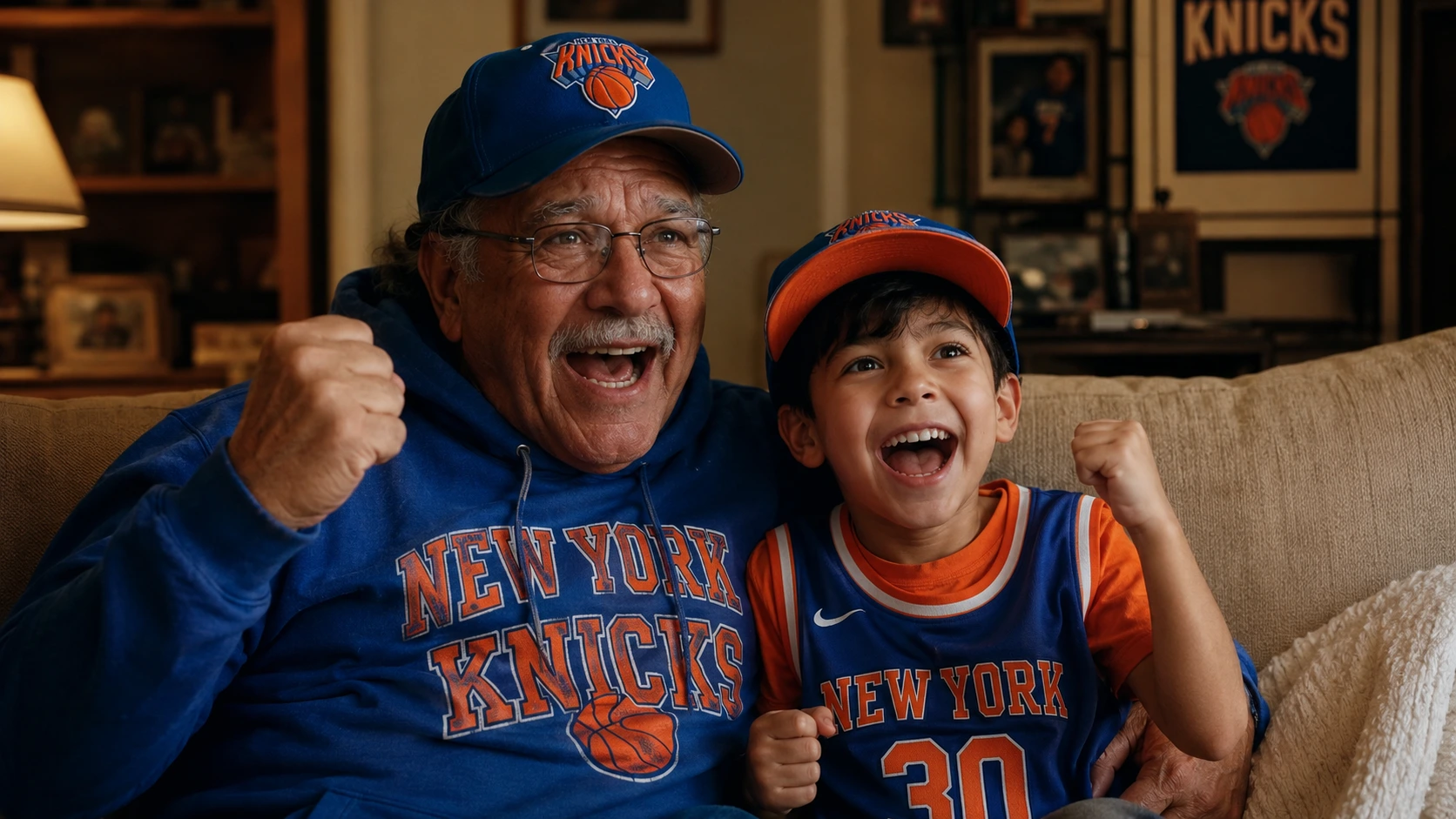
Most conversations about sports loyalty focus on the fans who stay through the losing. But the Knicks story is more specific and more meaningful than that. It is about what happens when loyalty becomes something you inherit. When the grandparent who was at Madison Square Garden in 1973 passes down the blue and orange to a child, and that child passes it down to their child, and somewhere in that chain of transmission something more than basketball gets transferred: a particular way of hoping, a particular tolerance for disappointment, a particular stubbornness about believing in something that has not yet given you a reason to.
Praise in Public: A Parenting Lesson From a Championship Night
The Knicks reached the NBA Finals in 1994 and 1999 but failed both times. Patrick Ewing, one of the most gifted big men in the history of the game, never won a championship in New York. Then came years of dysfunction, wasted draft picks, expensive mistakes, and seasons that ended in March before the playoffs even began. Through all of it, the fan base remained. Not because the team earned it. But because some loyalties are not contingent on results.
That is an unusual thing in contemporary life, where we are trained to optimize, to cut losses, to move on from anything that is not delivering returns. The Knicks fan who kept the faith through five decades of disappointment was practicing something that most productivity frameworks would call irrational. Psychologists might call it something else: a model of resilience and commitment that is genuinely rare and genuinely worth studying.
Children are watching how the adults in their lives handle disappointment. They are watching whether loyalty is something their parents model or something they only preach. They are watching whether hope is treated as a strength or quietly abandoned when it becomes inconvenient.
A parent who has cheered for a team through decades of losing is teaching their child something that no classroom curriculum can replicate. They are demonstrating, in real time, that some things are worth staying committed to even when they keep letting you down. That the value of belonging to something is not always determined by whether it wins. That there is a kind of character that only forms through sustained disappointment, and that character is worth more than any trophy.
Child development research consistently shows that children who observe adults modeling emotional resilience, who see the adults around them sustain hope through adversity and process disappointment without bitterness, develop stronger coping mechanisms and more stable emotional regulation than those who are only exposed to success. The Knicks, for five decades, were an unintentional masterclass in that modeling.
Every parent who took their kid to a losing game and said "we'll get them next year" and meant it was doing something quietly profound. Every grandparent who told the story of 1973 with genuine pride rather than mere nostalgia was keeping a flame alive that had meaning beyond basketball. The championship does not retroactively justify the wait. In many ways, the wait was already doing its work.
If there was a single moment in this championship run that crystallized everything the Knicks playoff journey had come to represent, it arrived in Game 4 of the NBA Finals against the Spurs. New York trailed by 29 points. Teams trailing by at least 29 points in the Finals had won only 12 times in the previous 4,088 such situations over three decades. The math was merciless.
The Knicks won on OG Anunoby's tip-in with 1.2 seconds remaining, 107-106, the largest comeback in NBA Finals history during the play-by-play era. It was the kind of thing that, had you described it in advance, would have sounded like a child's fantasy. And yet it happened. And it happened because a team that had been built to believe in the improbable, through a season full of double-digit deficit erasures, through a franchise history full of learning to keep showing up, simply refused to accept the math.
That refusal is the lesson. Not the win itself, but the refusal to stop believing in it. Children who watched that game, who asked their parents why the Knicks kept playing even when it looked impossible, received an answer that will be more useful to them than almost anything they will learn this year. Sometimes the scoreboard is wrong. Sometimes the gap is real but the deficit is not permanent. Sometimes you stay in it anyway, and sometimes that is enough.
One of the most powerful things families do, often without recognizing it as a deliberate act, is build shared narratives. The stories that get told at dinner tables and on car rides, the memories that are revisited and reframed as children grow older, are a significant part of how identity and values are transmitted across generations. Sports provides an unusually rich source of those narratives because the emotions are genuine, the outcomes are real, and the stories have clear arcs.
The Knicks championship is now a story that will be told in families for generations. The grandparent who remembers 1973 will sit next to the grandchild who remembers 2026. Between those two memories is an entire family history, compressed into the colors of a basketball team. That is not a small thing. Generational storytelling around shared experiences is one of the primary mechanisms through which families transmit their values, their humor, their capacity for joy, and their models of how to handle both winning and losing.
Tell the story. Tell the whole story, not just the championship but the drought, the heartbreaks, the years when hope felt genuinely foolish. That is the version with the most nutritional value for a young person trying to understand what kind of adults are worth becoming.
There is a particular expression on the face of someone who has waited a long time for something good. It is different from the expression of someone who expected to win and did. It is softer, somehow, and more complicated. There is relief in it, and disbelief, and something that looks almost like grief, as if the person is mourning the years of wanting even as they celebrate the arrival of what they wanted.
That expression was everywhere in New York on the night of June 13, 2026. And it is worth something to the children who saw it on the faces of the adults around them. It is evidence that things that take a long time can still arrive. That patience and loyalty are not just virtues that adults tell children to practice; they are things that adults actually live and that sometimes, not always but sometimes, they pay off in ways that make the waiting feel like it had a purpose all along.
The Knicks did not just win a championship. They validated 53 years of stubborn, irrational, beautiful faith. For every family that passed that faith down through the generations, the trophy belongs to all of them. And for every child watching their parent cry happy tears in front of the television for the first time, the education they received that night was worth more than any lesson plan.
The wait was the point. It always was.