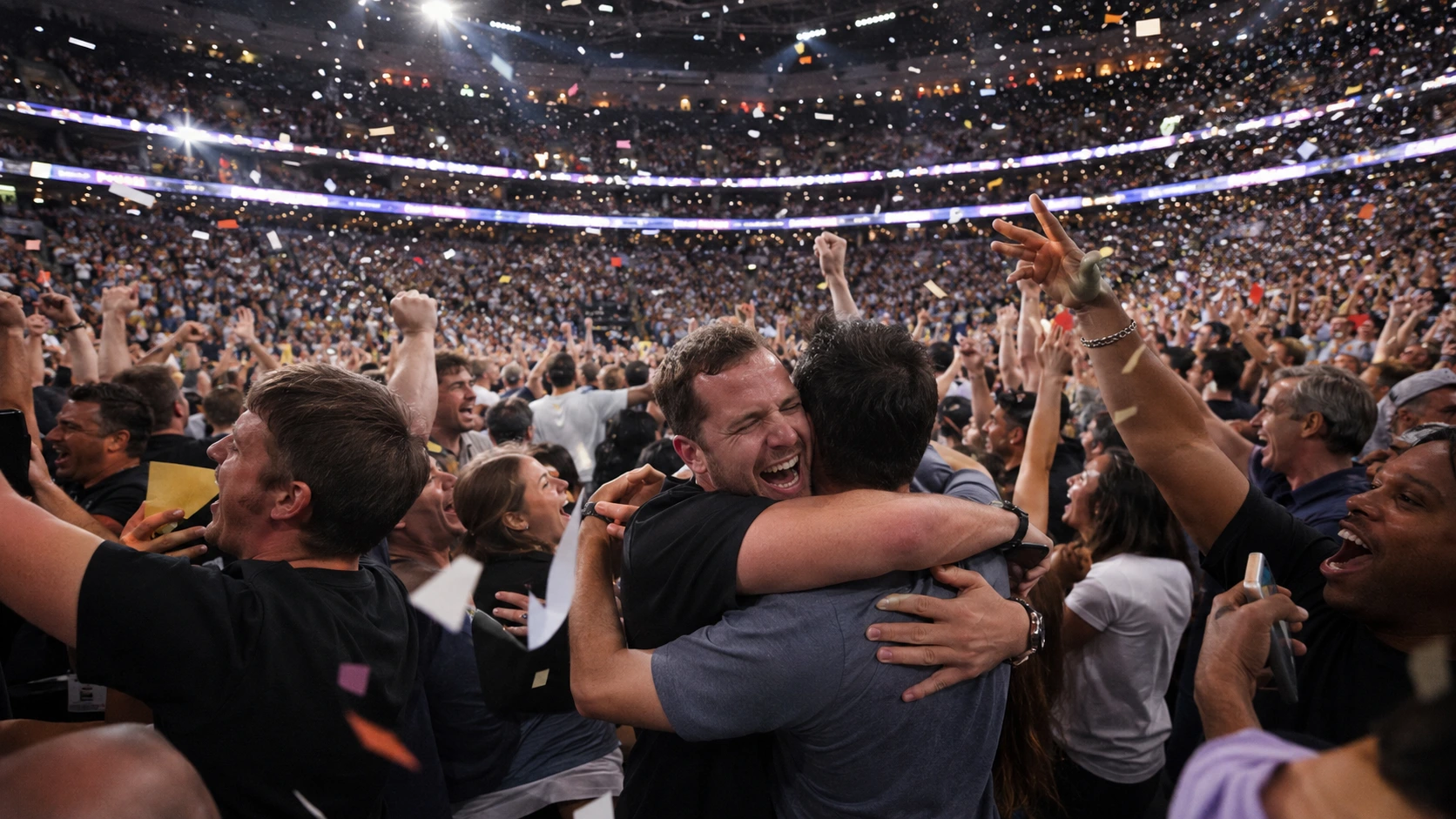
Something happened in arenas, living rooms, and bars across this country on the night the New York Knicks ended a 53-year championship drought. Something that had nothing to do with basketball. A man who had never spoken to the person next to him was suddenly embracing them. A woman who walked into a sports bar alone walked out with three new friends and everyone's phone numbers. Strangers who had spent their whole lives moving past each other in this fast, fractured world stopped, made eye contact, and felt, for one electric moment, that they were part of the same thing. That feeling has a name, and it turns out science has been studying it for more than a century.
It is called collective effervescence, and it may be one of the most underappreciated forces in human connection.
The term was coined by French sociologist Emile Durkheim, who spent his career trying to understand what holds communities together. His answer, arrived at through the study of religious rituals, tribal ceremonies, and communal gatherings, was that humans have a profound and biological need to experience themselves as part of something larger. When that experience is activated, in a crowd, in a moment of shared emotion, in a room where everyone is feeling the same thing at the same time, the result is collective effervescence: a heightened state of energy, excitement, and emotional intensity that temporarily dissolves the boundaries between strangers and replaces them with a felt sense of unity.
Durkheim observed this in religious contexts. Modern researchers have found it everywhere. Research from the University of Kansas shows that communal traditions create a palpable sense of unity and psychological well-being among fans. A 2022 meta-analysis published in Frontiers in Psychology reviewed 50 studies involving more than 182,000 participants across community celebrations, religious events, demonstrations, and sports gatherings, and consistently found that shared identity mediates the intensification of positive emotions and social bonding, elucidating the psychological antecedents through which collective effervescence produces positive crowd emotions and supports social cohesion during collective events.
In plain language: when we believe we are part of the same group, our positive emotions amplify, and the bonds we form in those moments are real.
Collective effervescence can arise in any context where people gather around a shared purpose. But sports fandom produces it with a particular consistency and intensity, and the reasons are worth understanding.
First, sports create what sociologists call a shared fate. Every person in that arena or watching that screen is genuinely uncertain about the outcome and genuinely invested in it. That uncertainty, held together by thousands of people simultaneously, produces a kind of synchronized emotional tension that few other communal experiences can replicate. When the tension breaks, in either direction, the release is collective. Everyone feels it at exactly the same moment.
Second, sports fan identity is one of the most cross-demographic forms of belonging that exists in modern life. A Knicks fan is a Knicks fan regardless of income, profession, neighborhood, age, or background. That shared identity strips away the usual social sorting mechanisms that keep people from connecting with those outside their immediate circle. The arena becomes one of the few spaces in contemporary life where a construction worker, a finance executive, a college student, and a retiree are all operating from the same emotional script.
Third, when people engage in synchronized activities, like singing, dancing, or chanting, their brains release endorphins, and collective experiences can increase oxytocin, the bonding hormone, which strengthens social ties. Every chant, every synchronized groan, every simultaneous leap to one's feet is a neurochemical event. The body is literally wiring itself for connection in real time.
The Knicks' championship run carried an emotional weight that made the collective experience even more powerful than a typical title celebration. The Knicks broke a 53-year title drought, defeating the San Antonio Spurs 94-90 in Game 5, with Jalen Brunson scoring 45 points. That was more than half a century and nearly a fifth of the time the United States has existed. In 1973, the team's current star player, Jalen Brunson, was 23 years away from being born.
That generational gap is not incidental to the emotional power of the celebration. It is central to it. The people filling arenas and watch parties this June were not just celebrating a basketball game. They were celebrating something they had inherited, a loyalty passed down through families across decades of disappointment, a hope that had survived heartbreak after heartbreak and somehow remained alive. When it finally paid off, the release carried all of that accumulated weight. Parents who had watched Patrick Ewing fall short were watching with children who had grown up hearing the stories. Grandparents who remembered Willis Reed were calling their grandchildren at midnight. The celebration was not just communal across space. It was communal across time.
The social bonding that happens around a shared sports moment is not a frivolous byproduct of entertainment. For families, it is a genuine opportunity. Research on family connection and community belonging consistently shows that shared rituals, experiences where the whole group is emotionally present together, are among the most powerful builders of relational closeness. The Thanksgiving dinner, the annual vacation, the family movie night, these work not because of their content but because of their structure: everyone is in it together, feeling the same things, building a shared memory.
A championship run does all of that on an amplified scale, and it does it beyond the family unit. It reaches into neighborhoods, workplaces, and public spaces. It gives people who would never otherwise interact a reason to acknowledge each other, to share something, to feel briefly that they are neighbors in a deeper sense than geography. In a cultural moment defined by increasing isolation, political polarization, and the retreat into individual screens and curated social media feeds, that kind of spontaneous communal joy is not trivial. It is genuinely rare, and genuinely necessary.
There is a particular kind of conversation that only happens in sports bars during championship games. It is unguarded in a way that most adult conversation is not. People say what they feel. They admit how much this matters to them. They share stories about their fathers taking them to their first game, about watching with someone who is no longer here, about what this team has meant to them through different chapters of their lives.
Those conversations happen because collective joy lowers the social defenses that normally keep us performing composure for strangers. When everyone in the room is openly, unashamedly invested, the usual rules about what you are allowed to express in public are briefly suspended. What fills the space instead is something closer to the emotional honesty that we usually only access with people we have known for years.
The stranger at the next barstool becomes a witness to something real about you. And you become a witness to something real about them. That is not nothing. In fact, research on social connection suggests it is precisely the kind of low-stakes authentic moment that seeds longer-term community bonds, the kind of micro-connection that, repeated across a city over many nights of a playoff run, actually changes the social texture of a place.
The final buzzer will have sounded by the time you read this. The confetti will have settled. But the community connection that championship moments produce does not have to end with the celebration. The science of collective effervescence tells us that shared experiences create lasting changes in how people perceive and relate to the communities they belong to. People who live through a moment like this together remember it as a before-and-after in their sense of belonging.
The question worth asking is not just how it felt, but how to build more of it. More shared rituals, more communal experiences, more moments where the usual sorting mechanisms fall away and what remains is the simple recognition that you are surrounded by people who care about the same things you do. Sports offers that with unusual reliability. But the principle extends further, into neighborhood gatherings, community events, family traditions, and any space where people are invited to feel something together rather than separately.
The Knicks gave New York a championship. What the crowd gave each other, in those hours of collective joy, was something harder to measure and perhaps more lasting: a reminder of what it feels like to belong.