
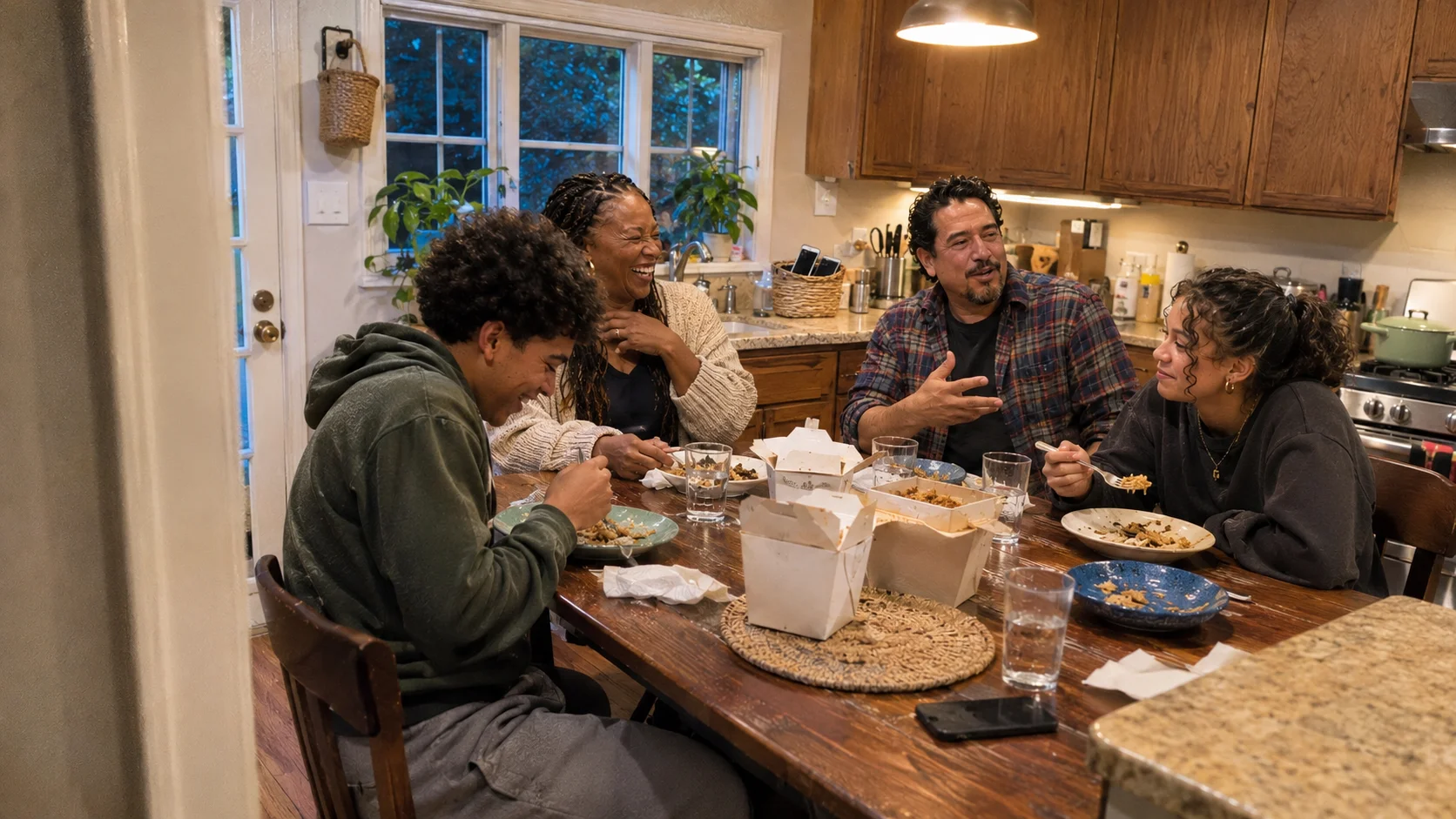
In a 2019-20 survey of 159,904 California students in grades 8, 10 and 12, those who ate with their families fewer than five times a week reported poor mental health at a rate of 36.4 percent. Among students who shared five or more family meals a week, the rate was 23.9 percent. Fewer than half of the students, 44.7 percent, said they ate with family that often.
Numbers like these travel fast, especially with Thanksgiving 11 days away and the family table about to become a national symbol for a few weeks. They have helped turn the family dinner into one of parenting's most repeated prescriptions, though the research behind that advice is more interesting, and more useful to a busy household, than the slogan suggests.
Regular family meals are consistently linked to better mental health in children and teenagers, but a good share of that link reflects the warmth and connection of the families who manage to eat together in the first place. The studies keep circling back to the meal as a reliable setting for conversation, which means what happens at the table, including whether the phones are put away, counts for more than the menu or the hour.
The California figures come from a 2023 analysis by Luo, Cummins and Zhu in Frontiers in Public Health, which found that less frequent family meals were associated with poorer mental health, with an odds ratio of 1.34. The authors were explicit that their survey design allows no conclusions about cause, a caveat that applies to most of this field.
Earlier reviews point the same way. A 2015 systematic review led by Megan Harrison in Canadian Family Physician, drawing on 14 studies, reported that frequent family meals were inversely associated with disordered eating, alcohol and substance use, violent behavior, and feelings of depression or thoughts of suicide in adolescents, and positively associated with self-esteem and school success, with the benefits appearing stronger for girls. In New Zealand, a 2017 study of about 8,500 secondary students led by Jennifer Utter found that more frequent family meals were tied to fewer depressive symptoms even after the researchers accounted for family connection and demographic factors.
Taken at face value, that is a strong case, and it leaves open the harder question of what the meal itself is doing. In 2012, sociologists Kelly Musick of Cornell University and Ann Meier of the University of Minnesota published a paper in the Journal of Marriage and Family that tested the family dinner more rigorously. Using national data on about 18,000 children, they examined depressive symptoms, substance use and delinquency, then controlled for other features of family life, and concluded, as Cornell's announcement summarized it, that most of the association between family meals and teen well-being is due to other aspects of the family environment.
Controlling for the quality of family relationships in particular explained much of the dinner's apparent effect, and analyses that followed the same teenagers over time produced even weaker evidence of a causal link. Musick did not dismiss the meal, which she described as one part of a larger package.
"Meals may afford a regular and positive context for parents to connect with children emotionally."
She also cautioned that it remains an open question how well a family dinner would work if it were pulled apart from everything else that package contains. Read alongside the Utter findings, which held after accounting for connection, the fairest summary is that some of the dinner's benefit is real and some belongs to the kind of family that makes dinner happen. Both readings point toward the same practical lesson: the value lies in family connection, and the table is one of the easiest places to build it.
One line of research has looked past how often families eat together to how the meals feel. Marie-Josée Harbec and Linda Pagani of the Université de Montréal followed children from age 6 and found that those whose early family meals were rated higher in quality reported less physical aggression, opposition and delinquency at age 10, and were fitter and drank fewer soft drinks. Pagani drew the conclusion directly in the university's release.
"Our findings suggest that family meals are not solely markers of home environment quality."
The Family Dinner Project, a nonprofit founded in 2010 that develops resources for families, builds its whole approach around that distinction. Anne Fishel, a family therapist whose guidance appears throughout the project's site, has framed it in a way parents can use: "it's what happens at the table that keeps them there." The same principle of short, predictable, low-pressure time together runs through our earlier guide to family meetings that run in 20 minutes.
If the conversation is the active ingredient, the most common thing that interferes with it is sitting next to the plate. In a 2014 observational study published in Pediatrics, Jenny Radesky and colleagues made 55 observations of caregivers eating with children in fast-food restaurants. Sixteen caregivers used a device almost continuously through the meal, and when adults were absorbed in their screens, many children escalated to limit-testing or provocative behavior to get attention.
Adults pay a price too. In a 2018 experiment at the University of British Columbia, researchers randomly asked more than 300 diners eating with friends or family either to keep their phones on the table or to put them away, and those with phones out enjoyed the meal about half a point less on a seven-point scale. Elizabeth Dunn, a co-author, summarized it plainly: "there is a real and detectable benefit from putting your phone away." For parents managing their own device habits, our piece on protecting parental mental health in a connected world covers the wider picture.
The research offers some relief to families whose schedules make nightly dinner impossible. The California study drew its line at five shared meals a week, and nothing in the findings suggests the benefit depends on the hour, so a weekday breakfast, a Saturday lunch or a late snack after practice can carry the same conversation if everyone is sitting down together and paying attention.
Keep the expectations small. A meal does not need to be home-cooked, long or calm to count, and the research on quality points to warmth rather than formality. With teenagers, a light and specific question about a teacher, a song or something funny from the day is often an easier opening than a request to report on how they feel, and one genuine exchange per meal is a better target than a full debrief.
Make the phone rule a household rule rather than a teen rule. A basket by the door or a shelf in another room works better than asking children to resist a device their parents are still checking, and when a call must be taken, saying so and stepping away from the table models the behavior without a lecture.
The Surgeon General's 2023 advisory on loneliness and social connection included a simple recommendation in its opening letter: make time to share a meal. Thanksgiving falls on November 26 this year, and for many families the most useful part of the day may be the conversation at the table, with the phones put away for an hour.